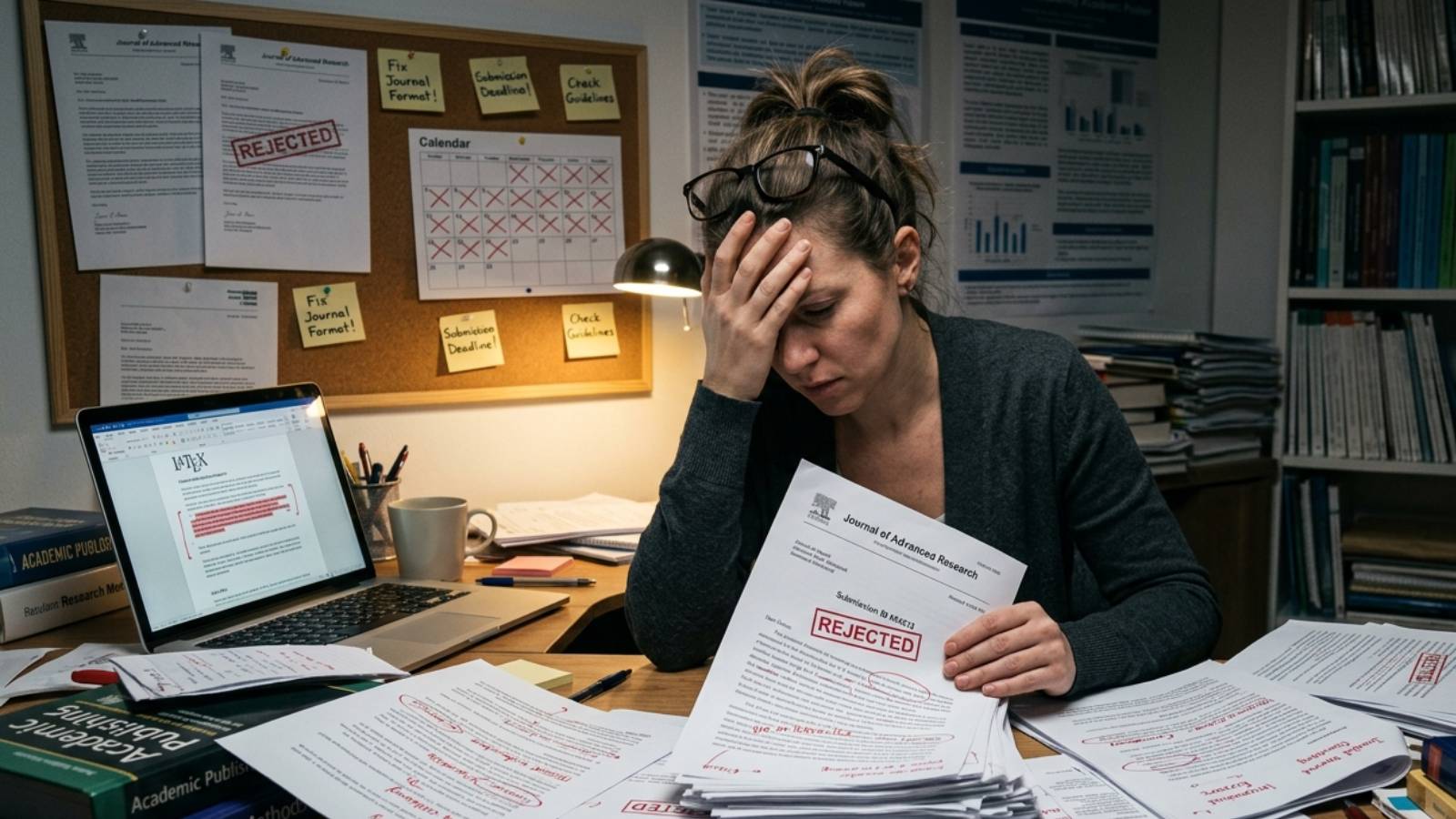
Journal Submission is a critical stage in academic publishing, where even well-researched papers can face rejection before reaching peer review. This early rejection, known as desk rejection, usually happens when the manuscript does not meet the basic expectations of the journal in terms of scope, quality, originality, or formatting.
Editors conduct a quick initial screening to ensure that only relevant, well-prepared, and high-quality manuscripts are forwarded for peer review. Understanding these rejection reasons helps authors avoid common mistakes and significantly improve their chances of acceptance.
Why Do Journals Reject Papers Before Peer Review?
Many journals reject manuscripts before peer review through an initial editorial screening, also called a desk rejection. This usually happens when the paper does not match the journal’s scope, lacks originality, has poor writing or formatting, contains methodological flaws, or fails to follow the journal’s submission guidelines. Editors use this process to ensure that only high-quality and relevant manuscripts are sent to peer reviewers, saving time for both reviewers and authors.
12 Journal Submission Mistakes to Avoid
Publishing in a reputed journal is not only about strong research—it also depends on presentation, compliance, and alignment with journal expectations. Many manuscripts are rejected during the initial screening due to avoidable mistakes. Below are some mistake to avoid during journal submission;
1. Submitting to the Wrong Journal
One of the most serious mistakes authors make is selecting a journal that does not match their research area. Every journal has a clearly defined scope, which determines what type of studies it accepts and publishes.
When a manuscript is submitted outside this scope, editors immediately identify the mismatch during the first screening stage. Even if the research is high quality, it is rejected because it does not serve the journal’s audience or subject focus.
This mistake often happens when authors focus only on journal reputation or impact factor without checking relevance. To avoid rejection, authors must carefully study the journal’s Aim and Scope, analyze recent published articles, and ensure that their topic aligns with previously accepted studies.
2. Ignoring the Journal’s Author Guidelines
Every journal provides detailed author guidelines that explain formatting rules, structure requirements, citation style, and submission procedures. These instructions are not optional—they are essential for acceptance.
Many manuscripts are rejected because authors fail to follow basic requirements such as incorrect word count, improper reference style, missing sections, or wrong file formatting. Even minor deviations show lack of attention to detail.
Editors prefer manuscripts that are already properly formatted because it reduces editorial workload and speeds up the review process. Submitting without following guidelines signals unprofessionalism and increases rejection chances even before peer review begins.
3. Writing a Weak or Unclear Title and Abstract
The title and abstract are the first sections editors evaluate, and they play a major role in the initial decision. If these sections are unclear, vague, or unstructured, the manuscript is often rejected immediately.
A weak title fails to clearly describe the research focus, while a poor abstract may miss important elements like objective, methods, results, or conclusion. In many cases, editors do not proceed further if they cannot quickly understand the study’s purpose and contribution.
A strong abstract must clearly present the research problem, explain how the study was conducted, highlight key findings, and state the significance of the results in a structured and logical flow.
4. Lack of Novelty or Research Contribution
Academic journals prioritize originality and meaningful research contribution. If a study does not offer anything new, it is usually rejected even if the methodology is correct and the writing is strong.
Many papers fail because they simply repeat existing findings without adding new insights, comparisons, or improvements. Editors look for innovation such as new datasets, improved analytical methods, or new interpretations of known problems.
To improve acceptance chances, authors must clearly explain what makes their work unique and how it contributes to the existing body of knowledge.
5. Poor Language, Grammar, and Readability
The quality of language plays a major role in editorial screening. If a manuscript is difficult to read due to grammar errors, unclear sentences, or poor flow, editors may reject it without sending it for review.
Even if the research is strong, poor readability reduces its impact and makes it hard for reviewers to understand the findings. Minor language issues can sometimes be corrected, but consistently weak writing reflects poor preparation and reduces credibility.
Professional proofreading or language editing services help improve clarity, structure, and academic tone.
6. Weak Research Design or Methodology
A strong methodology is the foundation of any research paper. If the research design is weak, the results cannot be trusted, leading to immediate rejection.
Common problems include small or biased sample size, lack of proper control groups, weak or incorrect statistical analysis, and unclear experimental procedures. Editors carefully evaluate whether the methodology is capable of producing valid and reproducible results.
If the study design is flawed, the research is considered scientifically unreliable regardless of how well it is written.
7. Ethical Compliance Problems
Journals strictly follow ethical publishing standards, and any violation leads to immediate rejection. Ethical issues are taken very seriously in academic publishing.
Common problems include missing ethical approval, lack of informed consent, plagiarism, duplicate publication, and data manipulation or image editing. Most journals use plagiarism detection software and image screening tools to ensure research integrity.
Even small ethical concerns can damage an author’s reputation and negatively affect future submissions.
8. Inadequate Literature Review
A strong literature review demonstrates the researcher’s understanding of existing studies. If this section is weak, the paper appears incomplete or poorly grounded.
Common issues include outdated references, missing key studies, and failure to clearly identify the research gap. Without proper context, the study may not appear relevant to current scientific discussions.
A good literature review connects the research with previous work and clearly explains why the new study is necessary.
9. Poor Data Presentation and Unsupported Conclusions
Even strong research can lose value if the data presentation is unclear. Poorly designed tables, unclear figures, or inconsistent results make it difficult for readers to understand the findings.
Another major issue is unsupported conclusions, where authors make claims that are not directly backed by data. Editors expect conclusions to be strictly based on evidence presented in the study.
Overstating results reduces scientific credibility and often leads to rejection.
10. Low-Quality Figures, Tables, and Supplementary Files
High-quality figures and tables are essential for clear communication of research findings. Low-resolution images, missing labels, and inconsistent formatting reduce readability and professionalism.
Many journals also require supplementary materials such as datasets, additional methods, or extended results. Missing or poorly prepared supplementary files can delay review or lead to rejection.
Clear and well-structured visuals improve understanding and strengthen the overall manuscript.
11. Missing or Incorrect Submission Documents
Journals require several mandatory submission documents along with the manuscript. These include the cover letter, conflict of interest statement, funding declaration, author contribution statement, and data availability statement.
If any of these documents are missing or incorrectly filled, the manuscript may be rejected during administrative screening before reaching peer review.
12. Careless Submission Errors
Simple mistakes during submission can also lead to rejection. These include incorrect author details, missing files, wrong manuscript versions, broken references, or incomplete citations.
Such errors reflect lack of attention and poor preparation. Even strong research can be rejected if the submission process is careless or incomplete.
Careful final checks before submission are essential to avoid desk rejection and ensure that all required documents and details are correctly provided.
Editor’s Pre-Submission Checklist
Before submitting your manuscript, use this checklist to avoid common rejection reasons and ensure your paper is ready for editorial screening.
- Journal scope verified – match topic with journal aim and scope
- Recent articles checked – ensure your topic fits published work
- Formatting followed – correct font, spacing, headings, structure
- Word limit checked – follow journal requirement strictly
- Reference style correct – APA, MLA, Vancouver, etc. as required
- Ethical approval included – for human/animal/sensitive research
- Informed consent added – if applicable
- Plagiarism checked – ensure originality of content
- Figures and tables reviewed – clear, labeled, high quality
- Data consistency checked – results match tables and analysis
- Cover letter prepared – highlight novelty and importance
- Declarations completed – conflict of interest, funding, author roles
- References updated – recent, relevant, and properly cited
- Manuscript proofread – grammar, clarity, and readability checked
- Final file check – correct version and complete submission files
Tips to Avoid in Journal Submission for Immediate Rejection
Submitting a research paper to a journal is a critical step in an academic journey, but many manuscripts face instant rejection at the editorial stage due to avoidable mistakes. Understanding how journals evaluate submissions can significantly improve your chances of reaching peer review.
Below are some practical and proven strategies to help you reduce rejection risks and strengthen your manuscript before submission.
- Read recently published papers from the target journal to understand style, structure, and scope alignment
- Study how accepted papers are written, formatted, and presented to match editorial expectations
- Use standard reporting guidelines such as CONSORT, PRISMA, STROBE, CARE, ARRIVE depending on your study type
- Ensure your manuscript fully follows the required checklist for transparency and research completeness
- Ask colleagues, mentors, or subject experts for a pre-submission review
- Collect feedback on clarity, methodology, logical flow, and overall scientific contribution
- Perform a final editorial-quality check before submission to avoid careless errors
- Correct grammar, formatting, references, and citation style issues before uploading
- Ensure all mandatory sections like ethics approval, funding details, and declarations are properly included
- Verify that tables, figures, and data presentation are accurate, clear, and journal-compliant
- Review the manuscript from an editor’s perspective, focusing on clarity, novelty, and presentation quality
Most journal rejections are not due to poor research quality but due to avoidable mistakes in journal selection, formatting, methodology, ethics, clarity, and submission preparation. Careful planning and strict adherence to guidelines significantly improve chances of acceptance.