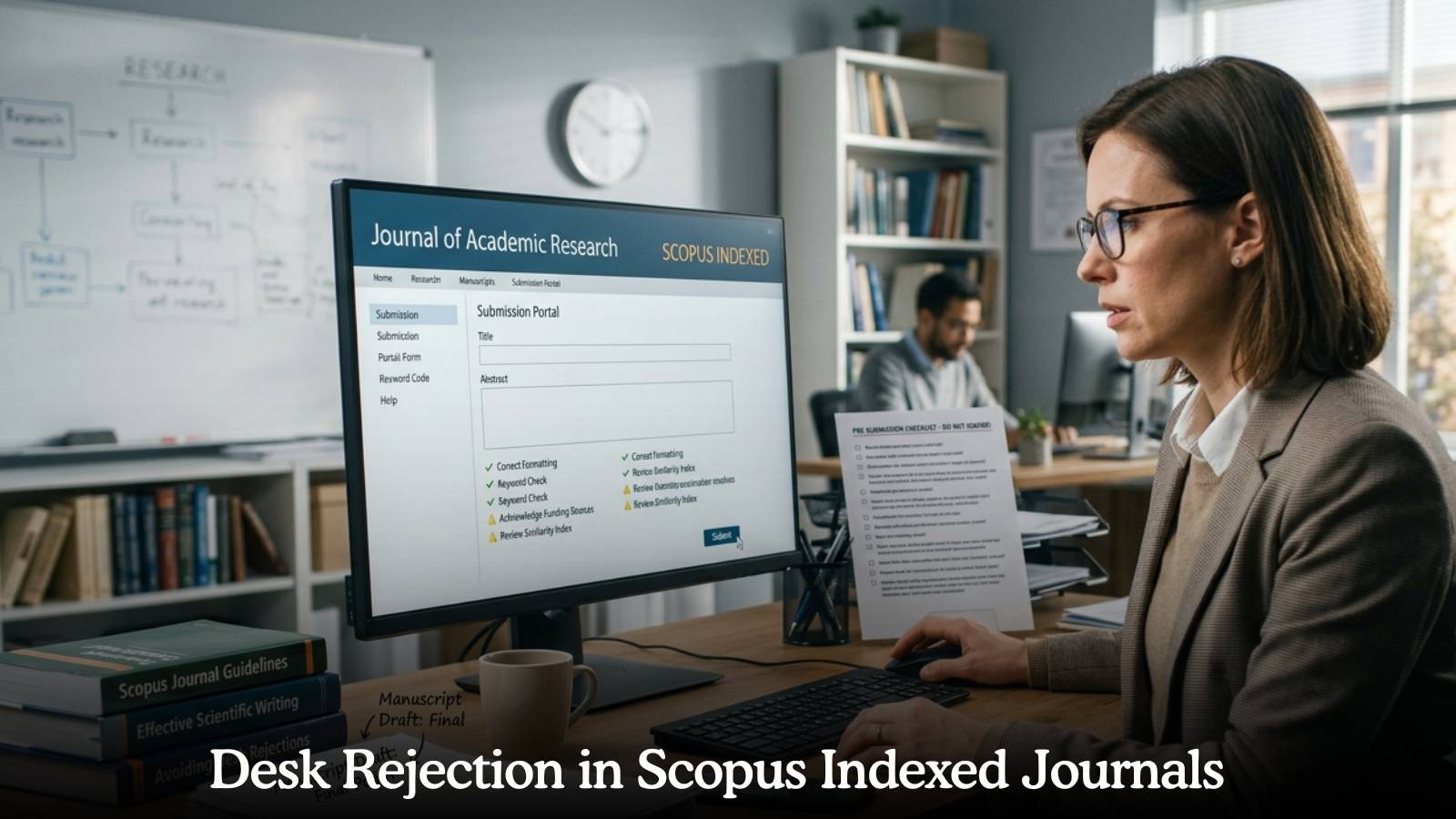
Desk Rejection in Scopus Indexed Journals occurs when a manuscript is rejected by the editor at the initial screening stage without being sent for peer review. This usually happens when the paper does not meet basic journal requirements such as scope relevance, originality, formatting standards, research quality, or ethical compliance. In Scopus indexed journals, editors make quick decisions based on the overall suitability and presentation of the manuscript.
Understanding how to avoid desk rejection is essential for improving publication success. It requires careful journal selection, proper adherence to author guidelines, clear writing, strong methodology, and ethical research practices. Below find the key reasons for rejection and practical ways to prepare a manuscript that meets editorial expectations.
What is Desk Rejection in Scopus Indexed Journals?
Desk rejection refers to the initial rejection of a manuscript by the editor without sending it for peer review. It is a screening stage where editors quickly evaluate whether the paper is suitable for the journal.
In many cases, journals indexed in Scopus and published by publishers like Elsevier reject papers within a few days if they do not meet basic criteria such as scope, quality, or formatting.
Unlike peer review rejection, desk rejection does not provide detailed feedback. The paper is simply considered unsuitable for further review, saving reviewer time and maintaining journal standards.
Major Reasons Why Scopus Journal Papers Get Desk Rejected
Most desk rejections happen not because research is absent, but because authors ignore essential publishing rules. Editors immediately filter out papers that show clear weaknesses.
One of the most common reasons is scope mismatch, where the topic does not align with the journal’s focus. Another major issue is lack of originality, where research does not contribute anything new.
Other frequent reasons include:
- High plagiarism similarity index
- Poor English language quality
- Missing journal formatting requirements
- Weak research methodology
- Ethical issues like missing approvals or consent
Even small mistakes can lead to rejection because editors handle hundreds of submissions daily and quickly filter unsuitable ones.
How to Select the Right Scopus Indexed Journal Before Submission
Choosing the correct journal is one of the most important steps in avoiding desk rejection. Many researchers make the mistake of submitting to high-impact journals without checking whether their work fits the journal scope. These journal submission mistakes often lead to immediate rejection even before peer review begins.
Every journal has a clearly defined aims and scope section, which should be studied carefully. Your research topic must closely match what the journal publishes.
Tools like Scopus journal search and publisher databases help identify relevant journals. Researchers should also avoid predatory journals that falsely claim Scopus indexing but lack proper peer review systems.
Selecting the right journal increases acceptance chances significantly and reduces unnecessary rejection cycles.
Writing a Strong Title and Abstract That Pass Editorial Screening
The title and abstract are the first things editors read, and they decide within seconds whether your paper is worth reviewing further. A weak title often leads to instant rejection.
A good title should be:
- Clear and specific
- Keyword-rich but natural
- Free from unnecessary jargon
The abstract should briefly explain:
- Research background
- Problem statement
- Methodology
- Key results
- Conclusion and contribution
Editors prefer abstracts that are structured, concise, and easy to understand. If the abstract is confusing or overloaded with technical terms, the manuscript is often rejected immediately.
Formatting Your Manuscript as per Scopus Journal Requirements
Every journal has strict formatting rules, and ignoring them is one of the fastest ways to get desk rejected. Even strong research can be rejected if formatting is not followed correctly.
Most Scopus journals follow the IMRAD structure:
- Introduction
- Methods
- Results
- And Discussion
Authors must also follow:
- Correct reference style (APA, IEEE, Harvard, etc.)
- Proper citation formatting
- Word limits and section guidelines
- Figure and table formatting rules
Many journals provide official templates. Submitting without using these templates often signals carelessness to editors.
How to Improve Research Quality to Avoid Instant Rejection
Research quality is the backbone of acceptance. Editors quickly assess whether your work adds value to the field or repeats existing studies.
A strong paper should clearly show:
- Novelty (what is new in your study)
- Clear research gap
- Strong methodology
- Reliable data analysis
Weak literature reviews or unclear research gaps are major red flags. If the contribution is not clearly stated, the paper is likely to be rejected without review.
Plagiarism, Ethics & AI Content Issues in Scopus Journals
Ethical integrity is taken very seriously in academic publishing. Even a small similarity issue can lead to immediate rejection.
Most journals expect plagiarism similarity to be below 10–15%, depending on the field. Self-plagiarism is also considered a serious issue.
Journals also require:
- Ethical approval for human/animal studies
- Consent statements where necessary
- Transparency in data usage
With increasing use of AI tools, journals are also becoming strict about AI-generated content without disclosure, which can lead to rejection.
Common Language & Writing Mistakes That Trigger Desk Rejection
Language quality plays a major role in editorial screening. Even if research is strong, poor writing can lead to rejection.
Common issues include:
- Grammar mistakes and unclear sentences
- Overly complex academic writing
- Lack of logical flow between sections
- Incorrect use of technical terms
Editors expect clear, professional, and readable English. Many authors use proofreading tools or professional editing services to improve manuscript quality before submission.
Author Guidelines: The Most Ignored but Critical Section
Author guidelines are often ignored, but they are one of the top reasons for desk rejection. Editors expect full compliance with journal instructions.
Important elements include:
- Word count limits
- Formatting structure
- File submission format
- Reference style rules
- Required declarations
Even small mistakes like incorrect margins or missing keywords can lead to rejection. Journals expect authors to carefully follow every instruction before submission.
How to Write a Powerful Cover Letter to Impress Editors
A cover letter is your first direct communication with the editor and should clearly explain why your manuscript is suitable for the journal.
A strong cover letter include
- Brief introduction of research
- Key findings and novelty
- Why the journal is the right fit
- Ethical declarations
A poorly written cover letter, or one that is too generic, can reduce the chances of your paper moving forward in the review process.
Final Pre-Submission Checklist to Avoid Desk Rejection
Before submitting your research manuscript, it is essential to perform a final and careful review to ensure it aligns with all journal requirements and editorial expectations. This checklist helps authors identify overlooked errors related to formatting, language, ethics, and compliance that often lead to immediate rejection. A thorough final check not only reduces the risk of desk rejection but also enhances the professionalism and acceptance potential of the manuscript.
Before submitting, every researcher should carefully review their manuscript to ensure it meets all journal expectations.
Key checklist items include:
- Journal scope match confirmed
- Formatting strictly followed
- Plagiarism report checked
- Language proofreading completed
- References properly formatted
- Ethical approvals included
This final check significantly reduces the risk of rejection and improves submission quality.
Expert Tips to Increase Acceptance in Scopus Indexed Journals
Successful publication in Scopus indexed journals depends on both research quality and submission strategy. A well-prepared manuscript that aligns with journal expectations has a much higher chance of acceptance and avoids unnecessary rejection cycles.
- Choose trending and relevant research topics with clear scope alignment
- Collaborate with experienced researchers to improve quality and credibility
- Target suitable (often mid-tier) Scopus indexed journals based on your level
- Revise the manuscript multiple times to improve clarity and structure
- Use professional editing to enhance language and readability
- Strictly follow journal author guidelines and formatting rules
- Clearly highlight novelty, contribution, and research gap
- Ensure ethical approvals and proper research integrity
- Conduct a final pre-submission review before submitting
Applying these simple but effective strategies significantly improves acceptance chances and reduces the risk of desk rejection.
Following journal guidelines, improving manuscript quality, ensuring originality, and maintaining ethical standards can greatly improve acceptance chances and reduce desk rejection risk.